
Welcome, 2026
happy new year
Dear Not Sorry Community,
What a year this week has been. The cycle of never-ending difficult news is truly gutting. If you’re grieving, angry, or afraid, we see you and feel that, too. We hope a reprieve comes to you and your community soon. We wish you every opportunity to lean into spaces that feel restorative and productive. Not productive in a “new year/better me” kind of way, but in a “better is possible” kind of way. Thanks for spending time with us now and always.
ART DIGEST:
Vanessa: Julia Whelan is here! First of all, can you tell the people who don’t know–though I’m sure everyone does–who you are and what you do?
Julia: Well, I’m not sure that everyone does, but hi! I am an audiobook narrator, an author, and the founder of the audio publishing company and retailer, Audiobrary, that is working to change audio publishing for the betterment of the people who actually make the product.
Vanessa: Love that. Workers’ rights for audiobook narrators.
Julia: Yes. And better royalties for authors. We do it all.
Vanessa: As a super-consumer of audiobooks, thank you for your work. You and your colleagues make my whole life better. Also, you are the author of truly one of my favorite Romance novels, Thank You for Listening.
Julia: Oh, thank you! And thank you for listening.
Vanessa: The book is so brilliant, the structure is so brilliant. And I’m sure it’s written smartly for the eye, but it suits your voice perfectly and is fittingly about the world of audiobook narrators. Are you so proud that you wrote a perfectly crafted book?
Julia: Truly, thank you, Vanessa. And I am proud! A lot of people want to talk about the meta nature of that book. And I personally don’t think it gets enough credit for the fact that it is a consciously thoughtful, well-constructed book.
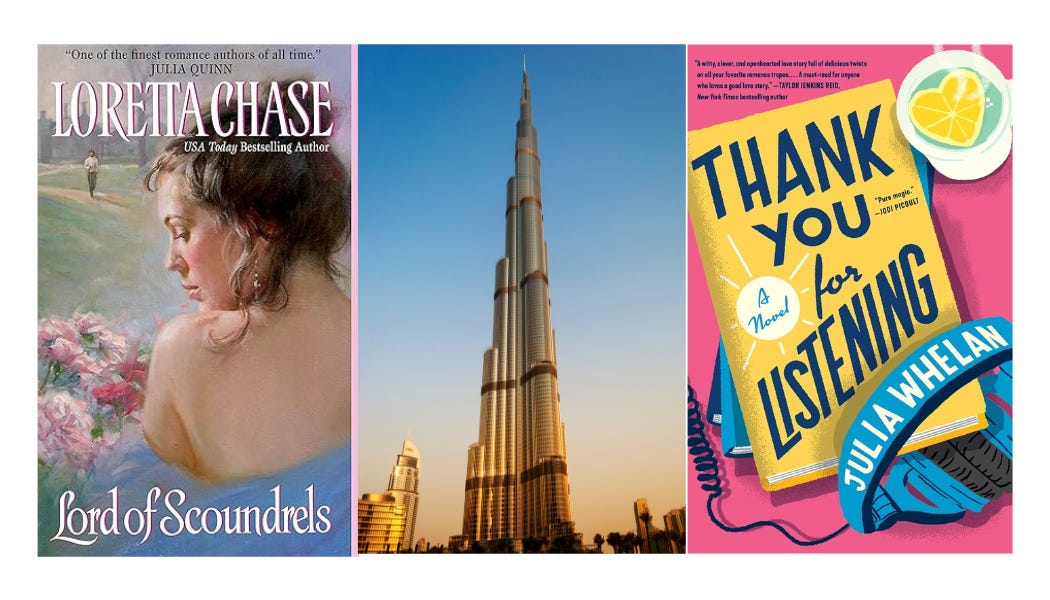
I joke that for someone who doesn’t do math, that book is as close as I will ever get to what I think the architect of the Burj Khalifa probably feels when he talks about how he built the tallest skyscraper in the world.
Vanessa: Yes! Like deeply knowing you told a perfect story at a dinner party. You nailed it.
Julia: Right, well it started as a kind of intellectual exercise to be perfectly honest. How can I make a send-up, almost satire, but something people want to read? A send-up of Romance novels that is very much structured like a Romance novel but bent just a little, so that it’s still surprising.
Vanessa: Yeah, and still so romantic, like without making fun of Romance readers.
Julia: Yes, right. It was tough. A few gray hairs over that one.
Vanessa: I could talk about the craft of your book forever, but instead I’ll tell everyone to please go listen. Hear for themselves.
And now for what I’ve called you to discuss today: Julia, if you had to tell the world one piece of art that they absolutely must consume, what is the one piece of art that you would recommend?
Julia: It’s a very good question, a question for which I have many answers. But I’m only going to talk about the thing that is consuming me at the moment. I have recently revisited one of my all-time favorite Romance novels, Loretta Chase’s Lord of Scoundrels.
Vanessa: Writing it down now.
Julia: Yes, order it. Sarah McLean and Jen Prokop, who host the podcast Faded Mates, did an episode on this book, and it’s one of Sarah’s favorite books ever. And I went back and reread it recently, and it’s one of those where you know it is the best the format can be. And after my reread, I’m gonna double down on that.
You can see the expectations of the genre (historical Romance), and you can understand how the novel is fulfilling them, but then it’s also operating at a level that is not seen by the human eye.
Vanessa: I recall this author from our Writing Romantic Stories class, which you and I co-taught in 2024.
Julia: Exactly. I used a Loretta Chase book as an example of how to establish character with economy in a very short amount of time. She probably does this better than anyone, especially in an opening sequence. Read all the beginnings of Loretta Chase’s novels. They’re cinematic, and they give you everything you need to know about the characters and that arc moving forward. And one of the other things about the beginning of Lord of Scoundrels is that it puts the “should people write prologues” argument to bed. Everyone who gets fatigued with prologues needs to read this perfect prologue.
Vanessa: Say more.
Julia: It justifies its existence, it is unlike any other prologue I’ve ever read in Romance in that it doesn’t even begin with our main characters. It is the definition of a prologue.
And I’m gobsmacked at the way she writes dialogue. There’s a knowing voice that I think is probably inherited from Jane Austen, especially when we’re talking about Regency, right? There’s a slyness to her characterizations, a commentary going on.
And it’s just delicious. Like, I cannot get enough.
Vanessa: I don’t usually ask two questions of our interviewees, so I apologize, but as the voice of the modern Romance novel, can you give me your elevator pitch on Romance?
Julia: The voice? Oh, my voice. I see what you did there.
Vanessa: For instance, mine is that we clearly have not yet figured out how to treat each other well as a society, so spending time in an imaginative space where love and hope are practiced is an automatic yes for betterment. What’s your pitch?
Julia Whelan: I think it is precisely that. And I think that’s why it’s irritating when Romance is cast off as escapism or fantasy. Why can’t women read about how they want to be treated? Why is that so far-fetched? Why is being treated with respect and having your pleasure prioritized and coming to terms with a man that makes you feel like the fullest version of yourself… please explain to me why that is within the realm of fantasy?
Vanessa: Right, women’s prioritization of themselves–sorry, out of reach. It’s basically like reading about zombies.
Julia: It is so disrespectful and cynical in a way that goes much deeper than shitting on the genre. It’s like shitting on everything that women should want.
Vanessa: Why are we teaching women to hope to be respected?
Julia: Yes, yes, precisely. And what historical does so well is implement stakes the reader can believe.
Contemporary Romance can often feel like there are no stakes because what could possibly keep people apart? And we know in real life there are many, many, many things that keep people apart–location, geography, trauma, family issues, texting habits. But we don’t buy those stakes as modern readers, all the little things that keep people apart are real, but we don’t believe that when we’re reading contemporary Romance. And with historical, the stakes become a lot easier to accept because they’re clearly external. Society, class, arranged marriages, things like that.
Vanessa: But historicals have really taken a beating recently.
Julia: Yes, traditional publishers are kind of turning away from them. They are hard to amass an audience for in indie publishing so for a while, it looked like they may die out. Now I’m seeing a backlash to that from readers and authors. And if we pull this off, if we save historical Romance, it’s going to be the victory of the community. And that is so gratifying.
And again, Sarah Maclean.
Vanessa: We love her. We love a community victory.
Julia: I forget how Sarah put it exactly, so I’m paraphrasing, but basically, Lord of Scoundrels transcends genre. Thanks for letting me go off. I had more to say about this than I realized.
Vanessa: Oh, a pleasure. Always so good to see you. Thank you for being so nice and normal.
Julia: Good to see you too. You’re so welcome!
OUR UPDATES:
Podcasts: As you know, a beautiful sunset is on the horizon for Harry Potter and the Sacred Text! With that comes our final two shows: HPST in Indianapolis with John Green on Friday, February 6, and HPST’s Virtual Live Show Finale on Thursday, February 26th. Join Matt and Vanessa in Indy or the entire HPST team from the comfort of your own home. We hope to see you there next month for these final shows.


The Real Question shifts to one episode per month in the new year, but our sincere hope is two episodes per month. Your support on Patreon ($2,000 a month in listener contributions!) determines what our team is able to produce, so if you love our small show, consider joining this January.
Programs: Our first class for A Year with Jane Austen began on Sunday, January 4th with Sense and Sensibility. The seminar taught by Vanessa and Julia Argy covers each of Austen’s six novels, dedicating four weeks to each book, and it meets every other Sunday. Registration is open through January 31st if you missed the first class and still wish to join, and the second book discussion (Pride and Prejudice) begins on March 1st.
Pilgrimages: As you may know, we launched two pilgrimages in December: As Always, Julia and Rebecca! We are thrilled to have three-time pilgrimage faculty Dana Schwartz step in as sole faculty for our time in France, and we could not be more excited to welcome first-time faculty Carmen Maria Machado, who will lead pilgrims through Cornwall in May.


And of course: our January art expert Julia Whelan has some exciting news later this month about a partnership with Common Ground. We invite you to subscribe to the Common Ground newsletter, where you’ll be among the first to hear about this incredible opportunity with her!
Hint: Julia Whelan’s pilgrimage novel is mentioned in this newsletter. <3
STAFF RECOMMENDATIONS:
Vanessa: I have started doing my face/skin care routine slowly and gently. I’m not SCRUBBING my face anymore but am lightly washing it-- the way that I would to a kid who I loved. And it feels so nice and slow. I look the same but it’s become a nice little ritual for me, and I recommend being gentle with yourself.
Dani: Instead of making a New Year’s resolution this year, some friends and I have come up with lists of fun things to do in 2026. There’s no pressure to complete them, it’s more of an inspiration board to try new things and spend more quality time together! This takes away the resolution pressure of “I’m going to develop a good habit or stop a bad one.” One of the things on my list, for example, is to go see shows at small local theatres, and hunt around for things that are a little off the beaten path!
Ariana: I don’t resist New Year’s resolutions because I believe we’re always changing, and I like having a ritual moment to embrace a sense of agency in that change. But what’s important for me, when making resolutions, is to resist creating an image of the ‘transformed/more perfect’ me. I’ve just started reading On Getting Better by the psychoanalyst Adam Phillips and I think this is a helpful passage from the preface:
“To be ambitious about change is more often than not to believe in change. Or rather, to believe in forms of change that we have some kind of say in. So to talk about getting better – about wanting to change in ways that we might choose and prefer – is to talk about pursuing the life we want, but in the full knowledge that our pictures of the life we want, of our version of a good life, come from or come out of what we have already experienced (we write the sentences we write because of the sentences we have read); and that how to get better and what we want to get better at are always changing. How can we talk differently about how we might want to change, knowing that all life is group life, and so depends upon collaboration; and knowing that change – personal and political change – precipitates us into an unpredictable future?”
I haven’t read the rest of the book yet, so I don’t know how he answers that question! But here’s how I’m starting: This year I’m thinking about my resolutions as small experiments in living rather than as long-term goals that I’m trying to achieve. My resolutions aren’t moralizing forces to discipline myself into a better person. Instead, they’re spaces of play that are meant to shake things up and open up possibilities.
Casper: My friend Nicholas recently asked me the question, “Think of three people you want to love more. Not people you feel you should love more, but people you want to love more. And then think about how you can do that. And I thought it was just the most marvelous invitation -- and one I share with you for this new year, too!
Addie: I take the opportunity to reflect back on the year, rather than make resolutions for the coming year. One question I often ask myself is, ‘what have I learned this year?’ Sometimes the answer is big, but often it’s small—some way I didn’t even realize I had grown, until it had already happened. This year, I got into very amateur astronomy. After many night time walks with my dog, I can now reliably identify Mars and Jupiter when they are visible in the night sky. This small practice of looking up has helped me feel grounded.
Anisa: Truthfully, I still find it hard to resist falling for the New Year’s resolution/self-improvement trap— especially when my algorithm is feeding me videos of people casually running marathons or writing 10,000 words in a day. Something that has helped, though, has been reorienting how I view certain goals for the year. If my mind is gravitating towards thinking about goals or resolutions anyway, rather than focusing on the productivity aspect or setting out to accomplish a specific achievement by a set time (and simply ticking things off a list), my hope is to instead focus on the experiences that go into the resolution/goal/etc. For example, instead of telling myself I have to read X amount of books this year, I might try to be more intentional about what I read, whether that entails reading a book or set of books in the mindset of a certain theme I’m interested in, or reading in community with a book club or friends. (That being said, I am still telling myself this is the year I finally read Anna Karenina and Middlemarch.)
Courtney: I’m making my bed. Every morning. I love a made bed, and I am finding that this one small shift in my routine feels 100% for me without the pressure of performing. It’s nothing other than my morning-self being kind to my evening-self.
I had no idea Not Sorry had a newsletter! This is fun news